
The Software Factory Production System
The Path to the AI-Native SDLC
Most organizations are making a critical mistake with AI adoption. They are inserting AI coding agents into a software delivery model that was already struggling.
The traditional SDLC depends on experienced humans compensating for structural inefficiencies every day. Product managers reconstruct customer intent across disconnected tools and meetings. Engineers fill gaps in vague requirements with tribal knowledge. Teams continuously synchronize through planning rituals, approvals, status updates, and handoffs.
AI agents cannot compensate for these gaps the same way humans can. They amplify the quality of the system around them and will scale those inefficiencies faster than ever before.
Before jamming agents into existing systems, it’s worth reevaluating how work gets organized.
Hierarchy historically existed to route information and coordinate across teams. Given a centralized knowledge base and a map of your organization, AI can increasingly handle the functions of routing context and coordinating work.
Teams consist of a set of specialists because people have historically been trained to do one specific job. AI is breaking down silos and expanding the range of work a single operator can own. Designers can now ship code. Engineers can do product thinking. When specialists encode their expertise into reusable AI skills and guardrails, individual operators are further empowered to drive end-to-end outcomes.
But for this leverage to be unlocked, operators need access to the full context behind the work. If context remains fragmented across meetings, documents, and tools, people still spend most of their time reconstructing information instead of building.
The opportunity is not to bolt AI onto a delivery model built around manual synchronization and specialization. The opportunity is to reorganize software delivery around the continuous flow of context itself.
Many of these ideas were recently explored in Block’s essay, From Hierarchy to Intelligence, which argues that organizations are moving from hierarchy-based coordination toward intelligence-based coordination powered by AI. What remains unclear for most enterprises is how to operationalize this shift.
At 8090, we are building Software Factory to enable this transformation.
Software Factory is an AI-native SDLC control plane that centralizes context, intelligently coordinates across systems, and enables individuals to operate across functional boundaries to deliver end-to-end outcomes.
As our teams at 8090 integrated Software Factory into their workflows, we have reorganized around a new operating model for AI-driven software development called the Software Factory Production System.
This article outlines the principles behind the Software Factory Production System and how organizations can begin applying it within their own teams.
A Brief Evolution of Software Delivery Models
Modern software delivery has evolved through several major operating models, each attempting to solve the limitations of the previous generation.
Waterfall
Early software systems were expensive to build, difficult to modify, and risky to deploy. Waterfall organized around upfront planning and sequential handoffs across requirements, design, implementation, testing, and deployment. Releases were delivered as large, infrequent “big bang” deployments where months or years of work shipped simultaneously.
However, long planning and release cycles made iteration slow, expensive, and difficult to adapt.
Agile
Agile teams began working in shorter iterations with continuous feedback and incremental releases. Organizations shifted from functional departments toward a set of cross-functional teams.
This improved adaptability, but ultimately optimized for delivery velocity at the expense of coherent, long-term system design. Continuous reprioritization and short planning horizons institutionalized scope creep, technical debt, and growing operational complexity.
Though Agile reorganized work into smaller cross-functional teams, the operating model within one team remained fragmented across functional specialists. Work still moved through meetings, planning rituals, approvals and handoffs to coordinate across role boundaries.
Lean
As software systems grew more complex, the industry increasingly adopted ideas from Lean manufacturing and the Toyota Production System. Lean software development placed greater emphasis on optimizing flow, limiting work in progress, and reducing waste through pull-based workflows, CI/CD, platform engineering, and DevOps.
However, Lean principles were applied primarily to engineering execution rather than the broader operating model. While engineering pipelines became more efficient, much of the organizational waste created by fragmented ownership, coordination overhead, and role specialization persisted.
To make matters worse, the modern software industrial complex has reinforced many of these coordination challenges by creating tools optimized for each individual function of the SDLC. As predicted by Conway’s Law, the emphasis on cross-functional teams has produced a sprawl of disconnected tools, siloed information, and growing coordination costs.
The Software Factory Production System
Previous generations of software delivery improved implementation, iteration speed, and engineering flow. AI changes something more fundamental: the economics of coordination itself.
The Software Factory Production System optimizes for the continuous flow of context across the entire SDLC. The system builds on Lean by extending its focus from the flow of engineering work to the flow of context, leveraging AI to eliminate coordination bottlenecks that were previously unavoidable and maximize individual ownership.
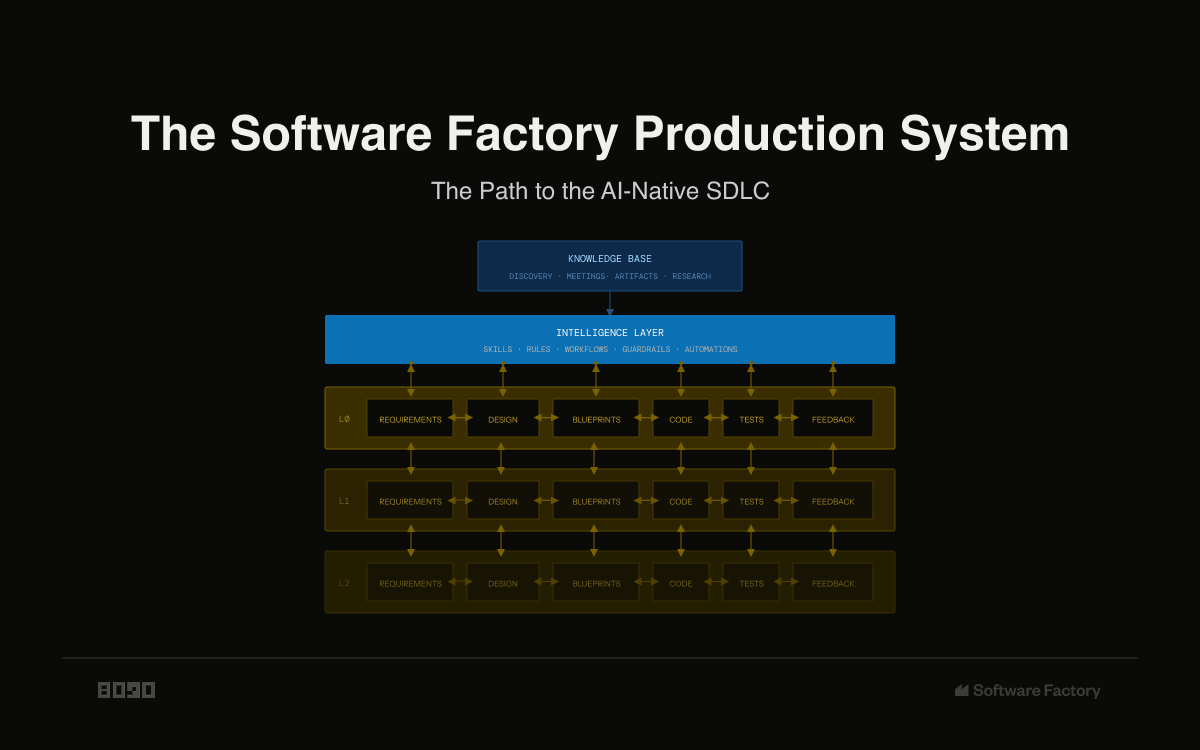
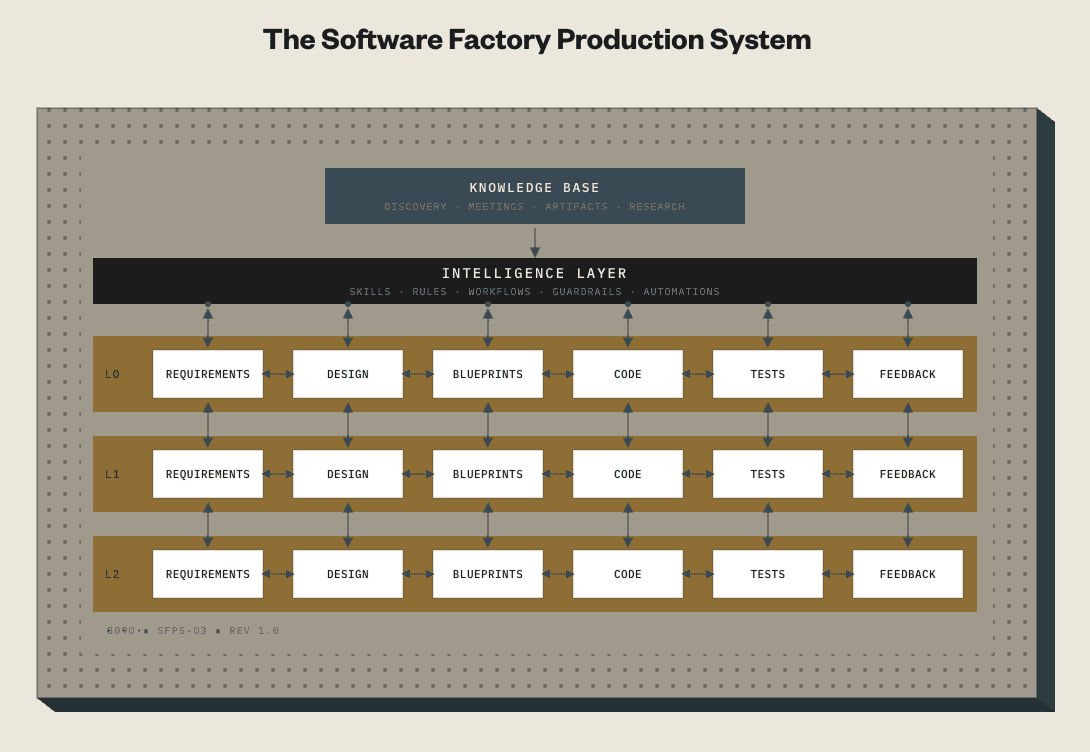
The Software Factory Production System is powered by four core components:
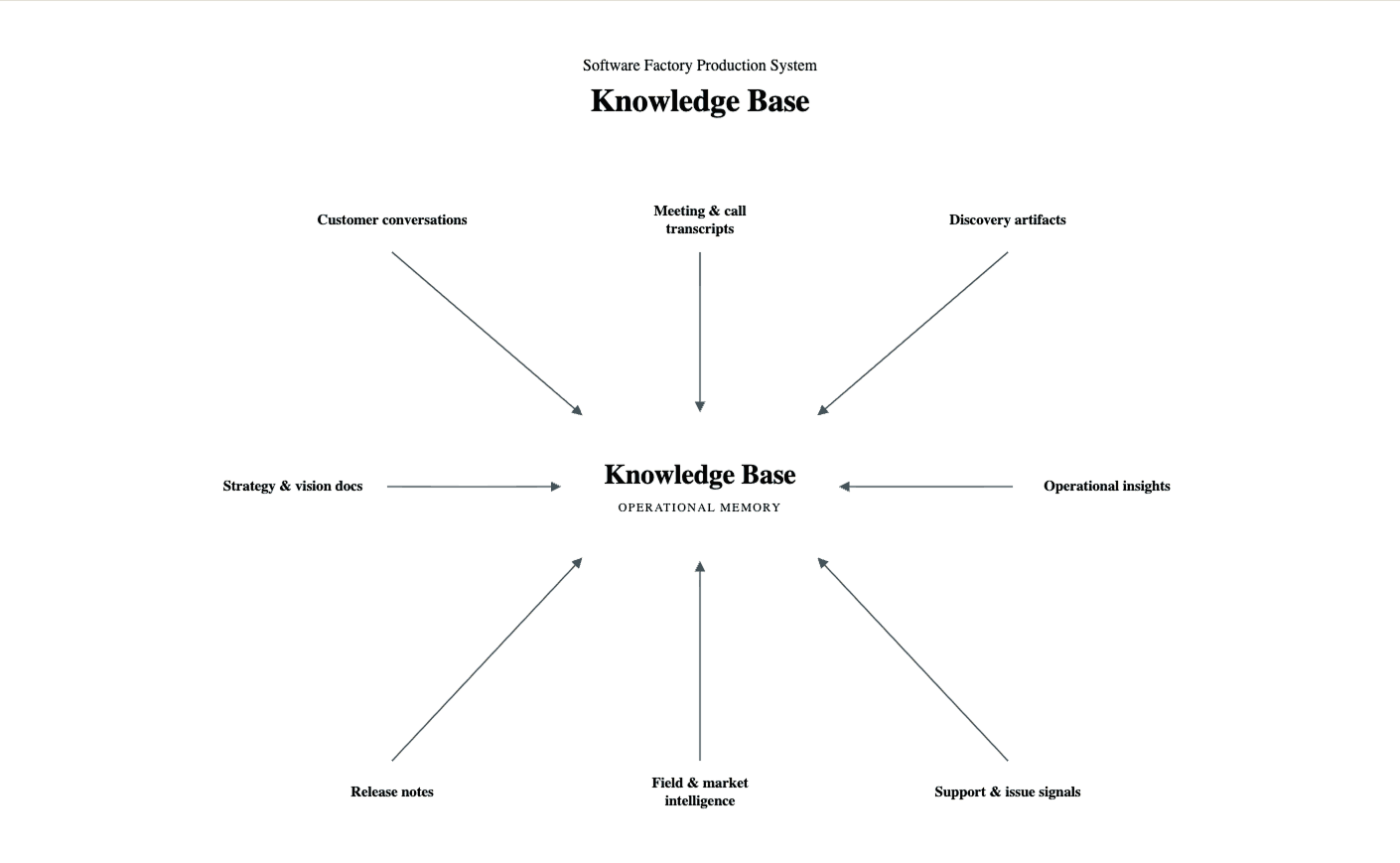
The Knowledge Base acts as the operational memory of the product. Customer conversations, discovery artifacts, strategy documents, operational insights, and field intelligence are continuously captured, structured, and connected into a centralized repository that lives in Software Factory.
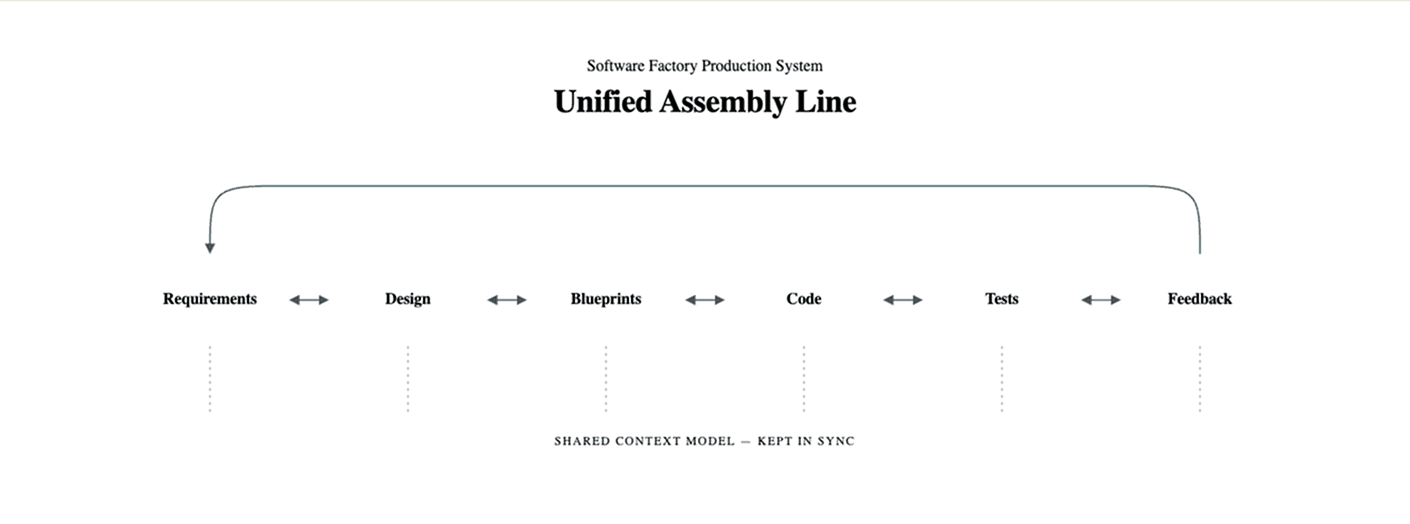
The Unified Assembly Line connects the end-to-end flow of software delivery into a single, continuous system. Requirements, design, architecture, implementation, testing, and operational feedback are linked together through a shared context model that maintains synchronization instead of fragmented workflows across disconnected tools.
Ownership boundaries are essential. The Factory Floor Plan defines how a product is broken down into a structured set of features and operational contexts. Each context is one assembly line in the factory owned by an individual. Products naturally contain dependencies and relationships between contexts. The Factory Floor Plan makes these relationships explicit, enabling clear ownership boundaries while allowing AI to intelligently coordinate execution, routing, and synchronization across assembly lines.
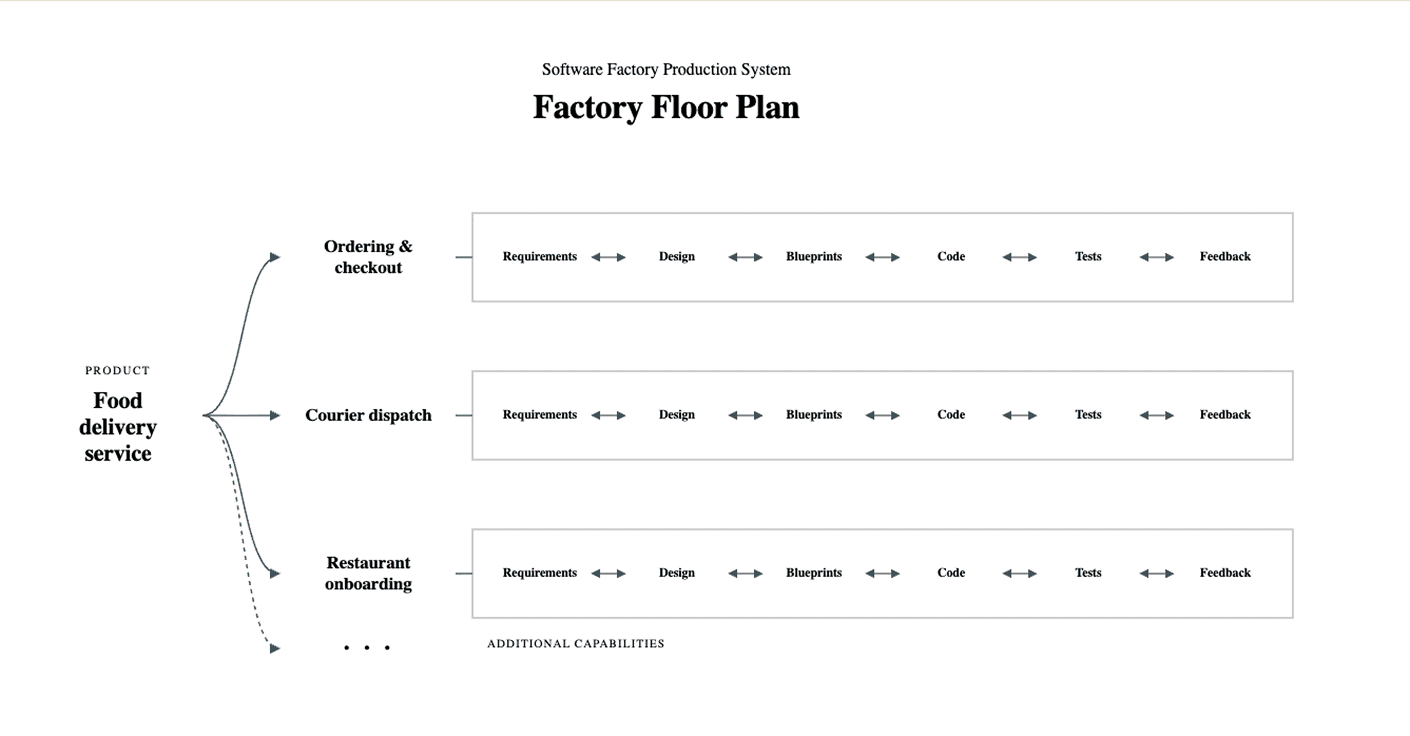
The Intelligence Layer makes expertise and coordination scalable. Specialists encode judgment, standards, workflows, and best practices into reusable skills, rules, and automations for the Software Factory agent to guide execution consistently at scale. These agents continuously reason across the system, coordinate dependencies, route information from the Knowledge Base, and enforce standards across workstreams.
These layers support a new set of roles optimized for AI-native software delivery.
Line Operators own the end-to-end execution of one or more assembly lines. Each assembly line is responsible for a distinct product capability, maintaining accountability for customer outcomes and system quality. They are empowered to operate across functional boundaries through the Intelligence Layer maintained by Factory Operators. Additional Line Operators may contribute work to a line as needed, but accountability remains with the designated owner. Discovery findings, decisions, and discussions are continuously recorded in the Knowledge Base, creating a traceable chain from customer needs to implementation outcomes for each line.
Line Operators are measured by yield: the volume of production that successfully meets the organization’s standards without requiring significant rework.
Factory Operators are domain specialists responsible for encoding expertise into reusable infrastructure. They act as force multipliers, developing reusable agent skills, standards, workflows, guardrails, and shared context that enable Line Operators to execute consistently across the factory.
For example, a product-focused Factory Operator defines requirement writing standards, codifies product principles and strategic direction. An engineering-focused Factory Operator establishes blueprinting standards, and maintains the coding agent harness based on implementation patterns observed across assembly lines. A design-focused Factory Operator maintains the design system and defines reusable interaction patterns.
Factory Operators regularly analyze work produced by assembly lines, identify recurring successes and failure modes, and encode those learnings into the Intelligence Layer and Knowledge Base. Research, decision logs, philosophy and strategy documents become durable organizational knowledge, while proven patterns are operationalized into reusable capabilities available to every Line Operator.
Factory Operators are measured by throughput: the rate at which product capabilities can be successfully delivered across the assembly lines as a result of operational leverage they provide to Line Operators.
Field Operators operate closest to customers and the external environment. They support custom configurations for customers and also capture operational feedback, customer needs, and market intelligence, continuously feeding new context back into the Knowledge Base where it can be intelligently routed to the appropriate workstreams. Field Operators are measured by signal resolution: how effectively customer needs, operational issues, and market feedback can be translated into actionable work across the factory.
Together, these components and roles create an operating model built on shared context, reusable intelligence, and end-to-end ownership. The result is higher quality, faster execution, and stronger ownership of outcomes.
Initial Results
The Software Factory Production System is still early, but the initial results have been significant. In the first few months, we are already seeing meaningful increases in both product quality and delivery throughput. Features are moving through assembly lines faster with less rework and coordination overhead.
More importantly, the nature of work inside the organization has begun to change. Line Operators display a significantly stronger sense of ownership, agency, and investment in the capabilities they operate. They are increasingly thinking in terms of complete customer outcomes and long-term system quality.
With the Intelligence Layer, expertise is becoming a property of the factory. At 8090, where co-op students comprise half of the organization, some of our newest team members are already producing work at a quality level that would have required experienced specialists only a few months ago. It has also proven effective at reducing coordination overhead across the factory. While some synchronous planning and alignment processes still remain as safeguards, ceremonies, manual synchronization, and organizational friction are declining week over week. As the value of these systems compounds over time, Factory Operators are increasingly excited to deepen the Intelligence Layer and identify new opportunities for operational leverage across the product.
Several capabilities of Software Factory remain experimental, particularly within the Knowledge Base and Intelligence Layer. These internal capabilities are evolving through active usage and will progressively become available to customers as they mature.
How To Start
Adopting the Software Factory Production System does not require organizations to completely restructure overnight. Software Factory is designed to be backwards-compatible with existing teams, workflows, and organizational structures, enabling an incremental transition toward an AI-native production system over time.
The first step is to bring your existing software delivery process into Software Factory. Organizations can import existing codebases, reverse engineer current systems into requirements and blueprints, connect existing tooling, and centralize operational knowledge. This applies equally to greenfield development and existing production systems.
Initially, most organizations will continue operating in cross-functional team structures while the Intelligence Layer and Knowledge Base are built up.
Over time, Factory Operators encode operational knowledge directly into the Intelligence Layer. As these systems mature, organizations can progressively empower high-agency operators to take ownership of one or more assembly lines, while specialists remain involved through mentorship, reviews, and quality oversight. These interactions continuously surface additional judgment and operational patterns that can be encoded back into the Intelligence Layer, creating a compounding cycle of organizational learning and operational leverage. As Line Operators become more capable, Factory Operators can increasingly focus on scaling systems, standards, and organizational leverage across broader areas of the product portfolio.
Organizations can get started directly with Software Factory today and begin mapping their software delivery operations into the platform. For larger organizations, enterprise agreements are available with expanded onboarding, training, and support.
We look forward to embarking on this journey together as we push the frontier of AI-native software delivery.
-1.png&w=3840&q=75&dpl=dpl_65ZqwWGWC3CwiRbLZnScZWoc3jtw)
-2.png&w=3840&q=75&dpl=dpl_65ZqwWGWC3CwiRbLZnScZWoc3jtw)